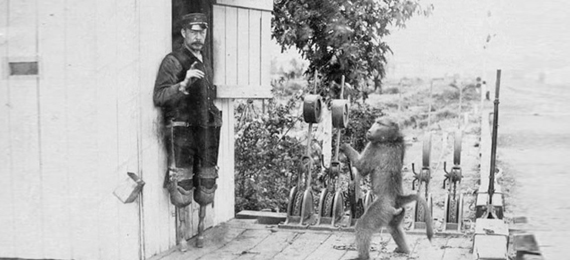
Did you know that a baboon once worked as a railway signalman? Sounds unbelievable, right? But Jack the Baboon was not just a pet—he was a real employee with a salary and an official railway job! Here’s the incredible true story of how a primate became a trusted worker in South Africa’s railroad history.
In 1881, Jack the Baboon became a signalman for the local railroad in South Africa. He was an assistant to a disabled railway signalman. He was also called a Chacma baboon, his real story was published in Nature, the scientific journal, in the 1890 July issue.
Quick Fact: Jack never made a single mistake in nine years!
How Long Has Jack Worked as an Assistant Signalman?
- A. 5 Years
- B. 10 Years
- C. 12 Years
- D. 9 Years
Jack Assistant Signalman
James Wide, a railwayman in South Africa, tragically lost his legs in a railway accident in 1887, forcing him to find an alternative way to continue his work. There was a ray of hope, he got an alternative position as a signalman and joined the job at the Uitenhage Station in South Africa.
After joining the new job, James saw a baboon working with a team of oxen wagon drivers. Baboon was helping him get around on a trolley.
Baboon soon became a special worker. He was in charge of keeping the gardens and also managed keys from the coal yard. James started to train Jack to operate the signals. Surprisingly over time, Jack learned by himself to say which train was approaching and also knew when levers needed to be pushed for the train. Jumper and Jack lived together in the Cottage which is located a half-mile away from the railroad.
Railway superintendent George B. Howe wrote about baboons when he visited the Baboon sometime around 1890. “Jack knows the signal whistle as well as I do, also every one of the levers.” Further added, “It was very touching to see his fondness for his master. As I drew near they were both sitting on the trolley. The baboon’s arms round his master’s neck, the other stroking Wide’s face.”
Quick Fact: He drank beer as a reward for his work.
How Long Has Jack Worked as an Assistant Signalman?
Reportedly Jack received an official employment number and was paid 20 cents a day and also got half a bottle of beer weekly. In 1890, Jack passed away due to tuberculosis. He worked on the railway for nine years without making any mistakes and proved animals can do their work perfectly.
He became a famous local celebrity and people visited him from around Cape Town to watch how the baboon operated the tracks.
Quick Fact: He had an official railway employee badge.
How Was Jack the Baboon Trained?
Jack the Baboon was trained through observation and repetition. His owner, James Wide, initially taught him to help with small tasks like fetching keys and moving objects. Over time, Jack learned to recognize train signals and operate the levers correctly by mimicking Wide’s actions. Astonishingly, Jack mastered the system without making any mistakes, proving his incredible intelligence and adaptability.
Was Jack Paid Like a Human Worker?
Surprisingly, yes! Jack received an official employment number from the railway company and was paid 20 cents per day, along with a weekly half-bottle of beer as a reward. His accuracy and reliability earned him recognition, and he became a local celebrity, with visitors coming from all over to watch the remarkable baboon in action.
Jack the Baboon proved that intelligence is not exclusive to humans. His remarkable ability to operate railway signals with precision remains one of the most extraordinary examples of animals in human history. His story is still remembered today as a testament to the bond between humans and animals and the unexpected ways in which animals can contribute to society.
Interesting Facts about Baboons that You Must Know
- Can you train a baboon?
Yes, baboons can be trained to follow instructions using repetition and rewards.
- Did Egyptians train baboons?
Yes, ancient Egyptians trained baboons for tasks like gathering food and participating in religious ceremonies.
- What did Jackie the Baboon do in WW1?
Jackie was a mascot for South African soldiers, trained to salute, stand guard, and even warn of enemy attacks.
- Will baboons replace humans?
No, baboons are intelligent but cannot fully replace humans in jobs due to their limited problem-solving skills.
- Are baboons stronger than humans?
Yes, baboons are physically stronger than humans, especially in upper body strength.
- How intelligent are baboons?
Baboons are very smart and can learn tasks, recognize patterns, and even use simple tools.
- Do baboons make good pets?
No, baboons do not make good pets. They are wild animals with strong instincts, high intelligence, and unpredictable behavior.