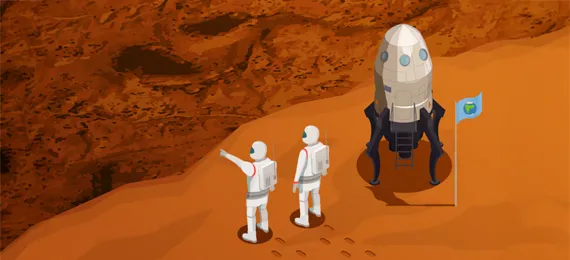
BAM! One moment I’m on Earth, the next I’m magically aboard the International Space Station (ISS) zipping around Earth. At first sight? A wild blue marble swirling below. (Astronauts say “watching Earth turn” is the all-time favorite pastime.) Cue dramatic music – oh wait, that’s just the fan noise (72 dB!) on the station. I realize I can’t lie down or sit normally: with no “up or down,” even my bed is a strappable sleeping bag in a closet-sized “sleep station”. I settle in, with earplugs and a sleep mask (thanks for the tip!) as the sunrise streaks by every 90 minutes.
Showers and Other Oddities
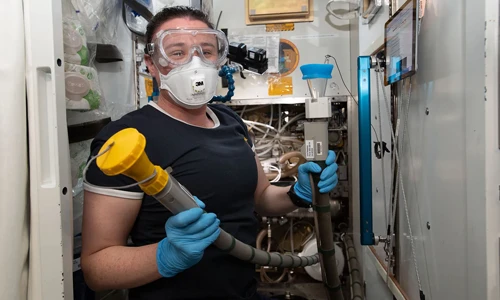
Turns out in space you do need to wash up – you just do it with a towel! On ISS, there are no showers. Instead, I use “rinseless” shampoo and special wipes. (NASA notes astronauts have the same hygiene needs as on Earth: “wash hair, brush teeth, shave,” etc., but no running water to rinse.) Picture me wrapped around a towel, squeezing foam shampoo into my hair; it’s like giving a cat a bath. Even our shaving kits have to guard against flying whiskers – male astronauts often skip razors entirely in orbit.
Who was the first human to travel into space?
- A. John Glenn
- B. Neil Armstrong
- C. Yuri Gagarin
- D. Alan Shepard
At mealtime, everything’s taped down: drinks in sealed squeeze-bags, food on magnetic plates. That’s because free-floating crumbs and splashes could short-circuit the station! On my first space taco (yes, tacos – tortillas are a standard now because they don’t crumble), I marvel: spicy spice is key up here since microgravity dulls taste buds. NASA history says early cosmonauts ate meat paste from tubes; today, we have nearly 200 menu items, from thermostabilized chicken curry to dehydrated jambalaya. Fresh fruits are a prize cargo – crews actually grow lettuce in orbit and gobble it happily.
Nature calls? Astronaut toilets are a sci-fi vacuum: you strap yourself in, flick on a fan, and let suction whisk waste away. (Yes, even our innards float in zero-G, so it feels weird at first.) Every drop of water – from breath to bath – is recycled by ISS systems. Skylab even had a tiny shower tube once (astronauts spent 2 hours bathing with 12 cups of water, and promptly abandoned it for space-custody of towels). Nowadays, every precious drop from my towel bath is fed right back into the loop.
Dining and Working Out at 17,500 Miles Per Hour
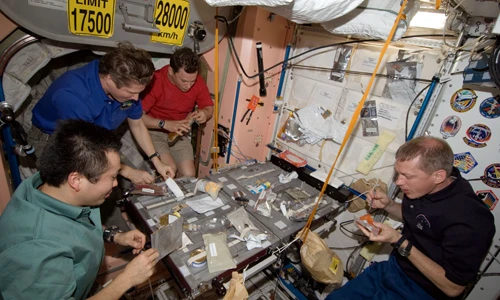
After freshening up, it’s breakfast time – which means floating eggs in zero-G. Everything adheres via magnets or Velcro. It sounds crazy, but NASA reports that “prolonged microgravity dulls taste buds,” so yes, I’m drenching this space-(beans)-on toast in Tabasco. Calories and entertainment come from pop songs piped in from Earth and watching the sunrise (again) through the cupola.
Work begins! Turns out “routine maintenance” is code for bench-pressing heavy gear that still has mass, even if it’s weightless. An inertial 100-lb toolbox is like wrestling a grizzly; I’m using muscles Earth-habit hardly cares about (and promptly regretting donuts left behind). Every day I strap down to the treadmill and the bike. No gravity means 30% bone loss per month without exercise, so NASA prescribes about two hours of workouts daily. I grin into my harness: on Earth I’d lag on a jog, here I’m flailing at 5K speed bouncing off the “tread” in midair. The advanced resistive exercise device (ARED) lets me lift “vacuum-cylinder weights,” effectively pumping iron in space.
Emotions, Tears, and Keeping in Touch
Space can be lonely. The crew is small, and Earth is far – CSA experts warn that distance makes communication challenging, breeding “stress and anxiety”. I put on my best grin for a video call, but actually it’s not a live video (hello, lag!). When I click a link on my laptop, the signal shoots 22,000 miles up to a satellite and back – it’s “worse than dial-up,” joked astronaut Scott Kelly. Still, I email, tweet (slowly), and watch the occasional downloaded movie on our mini-projector. NASA even lets astronauts watch pre-selected films – on my list: Gravity and Star Wars, which earlier crews truly enjoyed from orbit. It’s not exactly Netflix streaming; it’s more like “hard-drive on a loop,” but it beats circling Earth in silence.
Because of 16 sunrises a day, we live by GMT and mask our eyes to keep a sleep schedule. We sleep in coffin-size pods, zip up our sleeping bags to a wall or ceiling, and use fans to avoid dozing in a pocket of carbon dioxide. The astronauts tell me it feels strange at first; some even report a phantom float for days after returning to Earth.
Fun fact: Crying is a trip here. Water balls up on your face, so tears don’t stream – they form slimy orbs. Chris Hadfield explains: “Your eyes make tears, but they stick as a little ball”. They may sting as they pool, and big tears can float away if you’re not quick. So I keep tissues handy!
Still, purpose (and humor) keep the blues at bay. Every day, we help cure diseases, test new crops, or even grow lettuce. Working on groundbreaking science, seeing Earth without borders – it’s inspiring (the so-called overview effect). Studies show exploration gives usa new perspective on our place in the universe. And NASA notes, “dollars spent for space exploration create jobs, jumpstart businesses, and grow the economy” while spurring tech (from memory foam to MRI scanners). Even basic luxuries – GPS for navigation, weather forecasts from satellites – owe their start to those first rockets. Space tech gave us solar panels, implantable heart monitors, advanced water filters, better computing, and even global search-and-rescue systems.
A Timeline of Space Explorations
Before I jet off (er, come back to reality), let’s rewind Earth-side history. The space odyssey began not with a human but a metal ball – Sputnik 1 – in October 1957. That beeped its way around Earth and ignited the Space Race. Four years later, in April 1961, Yuri Gagarin became the first person in space with a single orbit of Earth. (Fun: he ate meat paste from an aluminum tube during flight.) The U.S. quickly followed: Alan Shepard’s suborbital hop in ’61 and John Glenn’s 1962 three-orbit flight. President Kennedy’s famous 1961 pledge led to Apollo, and on July 20, 1969, Neil Armstrong and Buzz Aldrin walked on the Moon for ~2.5 hours. (Look at this classic shot: Buzz Aldrin saluting the flag on the lunar surface.)
Spaceflight had its dark times too (Apollo 1 fire, Challenger, and Columbia tragedies), but each loss spurred tougher safety measures. We launched space stations: USSR’s Salyuts, America’s Skylab (1973), then Mir (1971–2001). In 1998, the International Space Station began assembly, becoming a permanent orbiting lab. Key projects followed: Hubble telescope (1990) peered into the cosmos, Mars rovers and Voyager probes expanded our horizons. Today’s stage is Artemis – NASA’s program (with SpaceX, Boeing, etc.) to send astronauts back to the Moon (first woman included) and use the Lunar Gateway outpost en route to Mars. Meanwhile, private companies (SpaceX, Blue Origin, Virgin Galactic) launched people into orbit and suborbitally, opening the era of space tourism.
Why Explore Space?
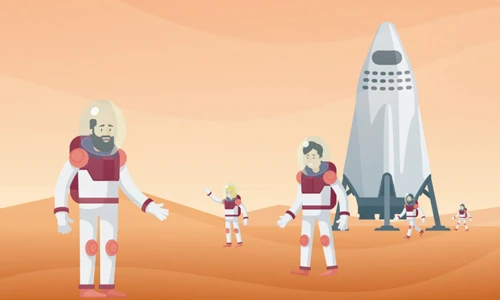
Space exploration is hard, costly, and dangerous – but it pays off big. For starters, it fuels innovation: satellites from early flights became GPS navigation and weather forecasting. Technology trickles down: the ISECG (space agencies group) report notes countless spinoffs “from solar panels to implantable heart monitors, cancer therapy, lightweight materials, water‐purification systems, improved computing… and global search-and-rescue systems”. NASA hails that its unique mission “improves daily life, advances medical research, [and] supports disaster response”. Every state, every country involved, gains high-tech jobs and scientific prestige from a launch.
Culturally, space ignites imaginations. Looking back at Earth convinces us to cherish and protect our fragile world. International crews on ISS (Americans, Russians, Japanese, Europeans, Canadians) have shown that cooperation can solve big problems. Discoveries – whether mapping planets or detecting dangerous asteroids – safeguard our future. And let’s not forget the thrill: who wouldn’t want to watch humans walk on Mars someday?
On a personal note: if Earth’s chaos is unbearable, there’s always Mars. (I’m joking… mostly.) But the advance of space tourism means that maybe anyone can see the blue marble from orbit. Cities on Mars might feel safer than some headlines!
FAQs
What exactly is space exploration?
Simply put, space exploration is the scientific study of outer space using rockets, telescopes, satellites, and spacecraft (with crews or robots) to discover cosmic secrets.
What did astronauts first eat in space?
The very first human space meal was Soviet cosmonaut Yuri Gagarin squeezing beef-liver paste from a tube (plus chocolate sauce) during his 1961 flight. Early US missions had apple sauce in a tube. Nowadays, ISS crews eat rehydratable and thermostabilized meals (up to ~200 menu items) and favor tortillas over bread to avoid crumbs.
How do astronauts shower or wash up in space?
They don’t shower – there’s no free-falling water. Instead, astronauts use rinseless shampoo and wet towels. NASA confirms there’s no shower on ISS; we use towels and special soaps (initially developed for hospital patients). All wastewater is recycled afterwards.
Can you sleep in zero gravity?
Absolutely – but you sleep tied down! Astronauts zip into sleeping bags attached to the wall or ceiling. They use earplugs and eye masks to block the constant noise and quick day-night cycles. Typically, they allot ~8½ hours, though many feel rested after ~6 hours in orbit.
How do tears behave in space?
Microgravity messes with tears: they don’t fall. Instead, tears form a floating ball on your cheek. Astronauts report tears “sting a bit” as they gather since they can’t stream away.
What kind of exercise do astronauts do?
To combat bone/muscle loss, each astronaut spends about two hours a day exercising. They strap themselves to a treadmill, a stationary bike, and a vacuum-cylinder weight machine (ARED) that simulates lifting heavy weights.
Why is space exploration important?
It drives tech, science, and society. Space research gave us satellites (GPS, weather), medical devices, new materials, and more. It also inspires people and shows Earth as a fragile home. NASA highlights that every $ in space yields $7+ back in economic output, plus jobs and innovations on Earth.
When did the first human moon landing happen?
Neil Armstrong set foot on the Moon on July 20, 1969, during Apollo 11. He was famously followed shortly by Buzz Aldrin; Michael Collins stayed in lunar orbit.
What is the International Space Station?
The ISS is a multinational space station begun in 1998 and continuously crewed since 2000. It serves as a research lab in low Earth orbit (about 250 miles up) where astronauts live and work.
How fast are we traveling on ISS?
At roughly 17,500 miles per hour, the ISS circles Earth once every 90 minutes! That’s why astronauts see 16 sunrises and sunsets each 24-hour “day”.
What’s next? Are people going to Mars?
The next big goal is Mars. NASA’s Artemis program will land astronauts back on the Moon (including the first woman) and establish lunar Gateway stations, as stepping stones for Mars missions. Several robotic rovers are already at Mars, and eventually humans will follow (maybe in 15–20 years). Private companies also plan space tourism, so in a few decades, you might be able to take that Earth-out-of-view vacation!