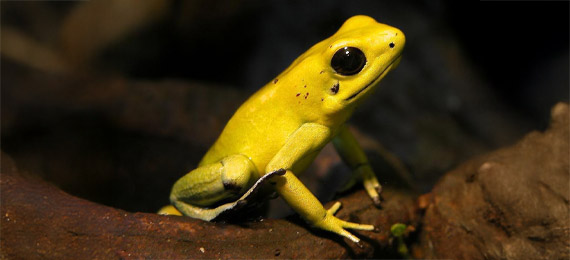
Let’s talk about the rainforest’s tiniest species (not the smallest cat) with a seriously bold defense system. Don’t let its bright yellow skin and small size fool you. This little amphibian is deadly. But beyond its reputation as the world’s most poisonous frog, there’s a whole world of amazing facts about the Golden poison dart frog: where it lives, what it eats, how it survives, and why it desperately needs our protection.
Geographic Distribution & Habitat
The golden poison dart frog (Phyllobates terribilis) is found exclusively along Colombia’s Pacific coast, particularly in the rainforests of the Cauca and Valle del Cauca departments. These regions are lush, humid, and bursting with biodiversity. The frog thrives in lowland tropical rainforests, often near small streams or leaf-littered forest floors.
Unfortunately, this narrow geographic range makes it highly vulnerable to habitat destruction.
Where is the golden poison dart frog naturally found?
- A. Brazil
- B. Colombia
- C. Ecuador
- D. Peru
Physical Characteristics & Size
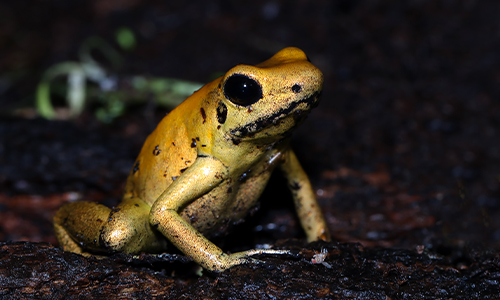
What makes this frog so iconic is its striking golden-yellow skin, which acts as a warning signal to predators. Some individuals may appear more orange or even greenish-yellow depending on where they’re found.
Size: 1.5 to 2 inches long
Weight: About 1 gram
Skin: Smooth and shiny, secreting a powerful toxin. Its bright coloring is a textbook example of aposematism, nature’s way of saying, “Stay away!”
Diet
In the wild,they feed on ants, termites, beetles, and other small insects, particularly those that contain toxic alkaloids. These alkaloids are the secret behind their deadly skin poison—one frog carries enough batrachotoxin to kill 10 humans!
Captive frogs fed on non-toxic insects lose their poison over time, proving the diet-toxin link.
Reproduction & Life Cycle
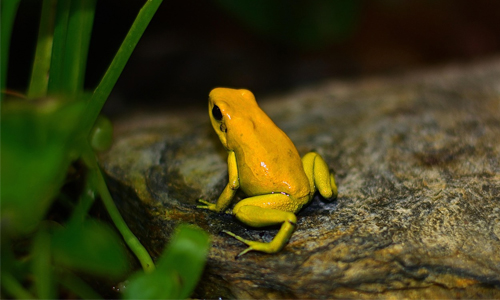
They are monogamous breeders. During mating season:
- Males call out using soft, trilling sounds to attract females.
- After mating, females lay 10–20 eggs in damp, hidden leaf litter.
- Once hatched, the male carries the tadpoles on his back to water sources like bromeliads or puddles.
- Metamorphosis takes about 2–3 months, after which the froglets become independent.
Behavior & Adaptation
Despite their size, these frogs are diurnal and territorial. They’re active during the day and fiercely defend their space.
Key adaptations include:
- Bright coloration for predator deterrence
- Potent skin toxins for chemical defense
- Excellent memory and navigation skills, used to relocate hidden eggs and return to their territories
- They also exhibit parental care, which is rare among amphibians.
Longevity
In the wild, these frogs may live up to 6 years. In captivity, with no predators and stable conditions, they can live up to 10 years or more.
Conservation Status
These frogs are currently listed as Endangered by the IUCN.
Threats include:
- Deforestation and habitat loss
- Illegal pet trade
- Pollution and climate change
Several zoos and conservation organizations, like the American Museum of Natural History and the Aquarium of the Pacific, are working to captive-breed and preserve the species through education and habitat protection.
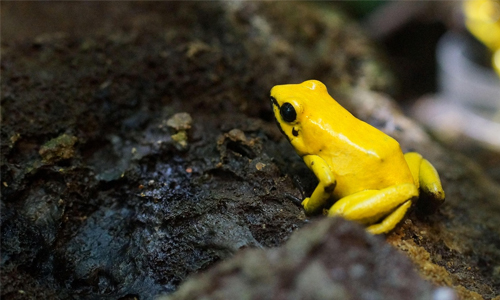
Fascinating Golden Poison Dart Frog Facts
- It’s the most poisonous and dangerous vertebra on Earth.
- Indigenous Colombian tribes used its toxin to tip blow darts—hence the name.
- Just 1 milligram of its toxin can kill up to 20 mice.
- Its poison doesn’t affect the frog itself.
- It only becomes toxic due to its insect-based diet.
- There are only three known species of frogs in its genus with potent batrachotoxins.
- A single frog’s toxin could kill 2 African elephants.
- Captive-bred frogs lose toxicity
- It has very few natural predators—only a few snakes are immune.
- Despite the danger, it’s a favorite among herpetologists for its beauty.
- Frogs raised in zoos are used to study possible medical applications of the toxin.
- The toxin affects nerve function, causing paralysis or cardiac arrest.
- The species is crucial for rainforest ecological balance.
- It’s one of the most studied frogs in terms of neurotoxic chemistry.
- The skin is hydrophobic, helping it avoid dehydration.
- It has a cloacal kiss
- They chirp, click, and trill—not croak.
- It’s a flagship species for amphibian conservation in Colombia.
- Females are usually slightly larger than males.
- Despite its fame, it remains elusive in the wild due to its remote habitat.
We hope you’ve learned enough fascinating facts to ace a trivia quiz on this incredible species.