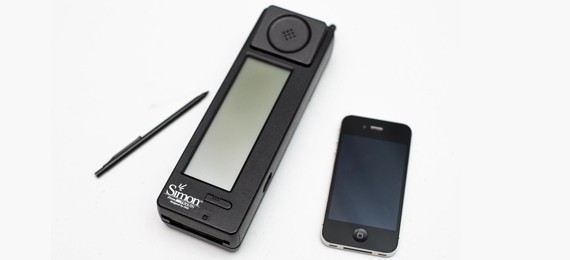
Most people assume the iPhone was the first smartphone. It wasn’t even close. Long before Steve Jobs stepped on stage in 2007, a bulky black brick called the IBM Simon Personal Communicator was quietly doing things no phone had ever done before — sending emails, running apps, and responding to a touchscreen. The year was 1994. Bill Clinton was president, the internet was barely a thing, and the world’s first smartphone was already in someone’s pocket.
Here are 10 things you probably didn’t know about it.
What Was the First Smartphone Ever Made?
1. When Was the First Smartphone Released for Consumer’s Use?
- A. 1993
- B. 1994
- C. 1995
- D. 1996
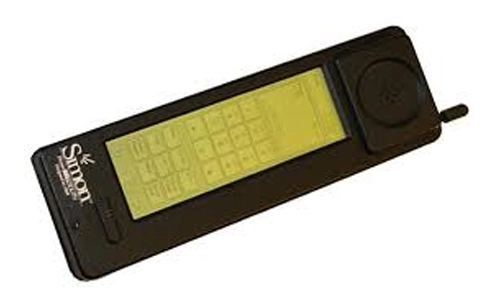
The first smartphone ever made was the IBM Simon Personal Communicator, released in August 1994. Designed by IBM and sold through BellSouth’s cellular network, Simon combined a mobile phone with a personal digital assistant (PDA) — something that had never been done before in a single handheld device.
It wasn’t called a “smartphone” at launch. That word didn’t even exist yet. IBM and BellSouth branded it a “personal communicator,” and the term smartphone wouldn’t appear in print until 1995. But by every definition we use today, the IBM Simon was the real deal — the world’s first smartphone.
1. It Was Invented 13 Years Before the iPhone
The iPhone launched in January 2007 to global fanfare. The IBM Simon launched in August 1994 to… considerably less fanfare. That’s a 13-year gap between the first smartphone and the one that made the world pay attention.
Frank Canova, the IBM engineer who led the Simon project, first demonstrated a working prototype at COMDEX in Las Vegas in November 1992 — a full 15 years before the iPhone. His team built it in the “Advanced Technology” department in Boca Raton, Florida, and the entire prototype was developed in just a few months.
2. Who Invented the First Smartphone?
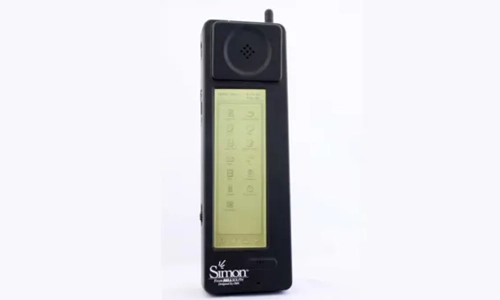
The first smartphone was invented by Frank Canova, an engineer at IBM. In July 1992, Canova demonstrated the core concept to IBM management using a touchscreen connected to a personal computer running Visual Basic. The idea was simple but radical: why carry a phone and a computer separately when you could have both in one device?
IBM then partnered with BellSouth to manufacture and sell the finished product. Mitsubishi Electric built the hardware after Motorola famously turned down the opportunity — reportedly because they were worried IBM might become a rival phone manufacturer. That turned out to be quite the costly pass.
3. The First Smartphone Had a Touchscreen in 1994
Yes, really. The IBM Simon featured a 4.5-inch resistive touchscreen display — years before touchscreens became standard on mobile devices. Users could navigate the interface with an included stylus, or with their finger, though the finger input was admittedly a little rough around the edges by today’s standards.
The Simon is widely credited as the first commercially available phone with a touchscreen. That’s a legacy that traces directly through to every iPhone, Galaxy, and Pixel you’ve ever held.
4. IBM Simon Features: What Could the First Smartphone Do?
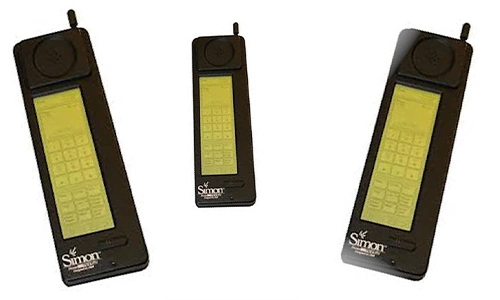
Quite a lot, actually. Here’s what was packed into that 1994 “brick”:
- Phone calls — make and receive cellular calls
- Email — send and receive emails (via a dial-up Lotus cc:Mail system)
- Fax — send and receive faxes directly from the device
- Address book — store and manage contacts
- Calendar and appointment scheduler
- Calculator
- World time clock
- Electronic notepad with handwriting support
- Predictive keyboard — IBM called it “PredictaKey,” an early form of predictive text
- Third-party apps — installable via PCMCIA card, making Simon arguably the world’s first app-compatible phone
It was, in many ways, a direct ancestor of the app-driven ecosystem we live in today.
5. How Much Did the First Smartphone Cost?
The IBM Simon launched at $899 with a two-year BellSouth contract, or $1,099 without one. In today’s money, that’s roughly $2,200 — which actually makes premium flagship pricing feel pretty familiar.
BellSouth eventually dropped the price to $599 (with a contract) before the device was discontinued. It was only available across 15 states on BellSouth’s AMPS analog cellular network, which limited its reach considerably.
6. The Battery Lasted About One Hour
Here’s where the Simon’s charm starts to wear thin: its nickel-cadmium battery provided approximately one hour of talk time. That’s not a typo. One hour.
An optional extended battery bumped that up slightly, but Simon was very much a device that needed to stay close to its charging base. The combination of weak battery life, hefty weight (around 500 grams), and a $899 price tag made daily use a commitment few were willing to make.
7. Only Around 50,000 Units Were Ever Sold
Despite its groundbreaking features, the IBM Simon was not a commercial success. Between its launch in August 1994 and its quiet discontinuation in early 1995 — just six months on the market — BellSouth sold approximately 50,000 units.
To put that in perspective: Apple sold over six million of the original iPhone in its first year. But Simon was operating in a world with no internet infrastructure, spotty cellular coverage, and zero consumer awareness that a “smartphone” was even a thing worth wanting.
Those 50,000 units are now rare collector’s items. Working Simon devices can fetch thousands of dollars at auction.
8. The Word “Smartphone” Didn’t Exist When It Launched
The term smartphone was not coined until 1995 — a full year after the Simon went on sale. It first appeared in print describing AT&T’s PhoneWriter Communicator. IBM and BellSouth had invented the category before anyone had a name for it.
This is a recurring theme in tech history: the most transformative inventions often arrive before the language to describe them exists.
9. It Was Featured in a Hollywood Film
The IBM Simon made a cameo appearance in the 1995 thriller The Net, starring Sandra Bullock — fitting for a device that was, in its own way, ahead of its time. It has also appeared more recently in the Apple TV+ series For All Mankind, cementing its status as a piece of cultural and technological history.
10. It Inspired Everything That Came After
IBM briefly developed a follow-up device code-named “Neon”, which was described as being roughly iPhone-sized with a 320×480 pixel LCD, auto-rotating screen when tilted, and digital radio. It was remarkable foresight.
But IBM began downsizing its Boca Raton operations, the original team was dispersed, and the Neon project was eventually abandoned. IBM left smartphone development to other companies — and the rest, as they say, is history.
The Simon’s DNA, however, lived on. The Palm Pilot, the BlackBerry, the first Android devices, and eventually the iPhone all built on the concept Simon proved was possible: a single device that could communicate, compute, and connect.
First Smartphone vs. the iPhone: How Different Were They?
| Feature | IBM Simon (1994) | Apple iPhone (2007) |
| Touchscreen | Yes — resistive, stylus | Yes — capacitive, finger |
| App support | Yes — via PCMCIA card | Yes — App Store |
| Yes | Yes | |
| Web browser | No | Yes |
| Camera | No | 2MP |
| Battery life | ~1 hour | ~8 hours talk time |
| Price at launch | $899 (contract) | $499–$599 |
| Units sold | ~50,000 (6 months) | 6+ million (first year) |
| Operating system | Custom DOS-based UI | iOS |
The iPhone didn’t invent the smartphone. It perfected it.
Why Did the First Smartphone Fail Commercially?
The IBM Simon failed commercially for a handful of clear reasons:
- Price — nearly $1,000 was steep even for business users
- Battery life — one hour of use made it impractical as a daily driver
- Network coverage — limited to 15 states on BellSouth’s analog network
- Market timing — consumers had no frame of reference for what a “smartphone” was or why they’d want one
- No internet — the mobile web didn’t exist yet, removing the killer use case that would later make smartphones indispensable
Simon wasn’t a failure of vision. It was a failure of timing. The infrastructure the world needed to make a smartphone indispensable simply didn’t exist in 1994.
Frequently Asked Questions
What was the first smartphone ever made?
The first smartphone ever made was the IBM Simon Personal Communicator, released in August 1994 by IBM and BellSouth.
Who invented the first smartphone?
The first smartphone was invented by IBM engineer Frank Canova and his team at IBM’s Advanced Technology department in Boca Raton, Florida.
How much did the first smartphone cost?
The IBM Simon, the world’s first smartphone, cost $899 with a two-year contract or $1,099 without — equivalent to roughly $2,200 in today’s money.
Was the iPhone the first smartphone?
No. The first smartphone was the IBM Simon in 1994 — 13 years before Apple launched the iPhone in 2007.
Why did the first smartphone fail?
The IBM Simon struggled due to poor battery life (about one hour), a high price point, limited network availability, and a lack of consumer demand for smartphone features in 1994.
How many first smartphones were sold?
Approximately 50,000 IBM Simon units were sold between August 1994 and early 1995, when it was discontinued.
The first smartphone wasn’t a sleek glass rectangle with a glowing apple on the back. It was a heavy black brick with a stylus, a one-hour battery, and a price tag that would make most people wince. But it was also a genuine leap forward — proof that one device could handle calls, email, apps, and a touchscreen interface years before anyone thought to call that combination a “smartphone.”
The next time you scroll through your phone, spare a thought for Frank Canova and the IBM Simon. Every swipe you take traces back to 1994.