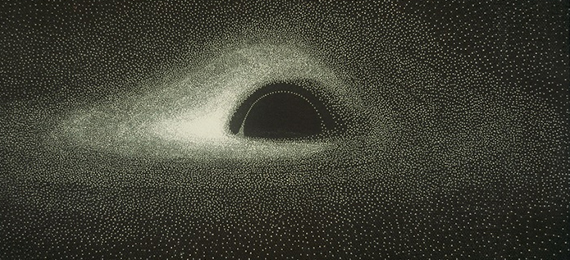
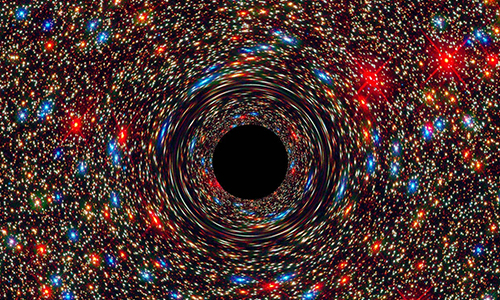
Look at this wild picture! It’s not sci-fi—it’s an artist’s illustration of a black hole. In space, a black hole is a spot where gravity has gone totally bonkers so strong that not even light can escape. In other words, a black hole is an extremely dense object (often the remnant of a dead star) with gravity so fierce that once something gets too close, nothing gets out. Scientists describe it as “a dense, compact object whose gravitational pull is so strong that nothing can escape, not even light”.
Because no light can come out, black holes themselves are invisible. We only know they’re there by what they do to nearby gas, stars, or light. Black holes warp space and time. Imagine putting a bowling ball on a trampoline – the sheet dips. A black hole is like an extreme bowling ball that dents spacetime so deeply that a marble (or a light beam) would spiral in and never come back out. We’ll unpack all this in a fun, step-by-step way below – but remember, what we call “holes” are actually giant clumps of gravity and crushed-up matter.
How Are Black Holes Formed?
What is a black hole?
- A. A dark planet
- B. A vacuum in space
- C. A region in space where gravity is so strong that even light can’t escape
- D. A hole created by aliens
Most black holes are born from dying stars. When a really massive star (several times bigger than our Sun) uses up its fuel, it collapses under its own weight. The outer layers explode in a supernova, and the core implodes into a tiny, super-dense ball. If that leftover core is heavy enough, it becomes a black hole. Basically, all that mass gets squeezed into a tiny space (hence the extreme gravity).
Primordial Black Holes
Some theories say the tiniest black holes formed in the first moments after the Big Bang. These would be tiny (maybe as small as atoms) but extremely dense.
Stellar Black Holes
The most common type is formed when massive stars die. If a star over ~8–10 times the Sun’s mass explodes and its core collapses, it can leave a black hole. Think of it as a stellar vacuum left behind.
Supermassive Black Holes
These giants (millions to billions of times the Sun’s mass) formed alongside galaxies. Every big galaxy – including our Milky Way – has one at its center. They may have grown by gobbling up gas and merging with other black holes as the galaxy grew.
NASA puts it simply: a black hole is what happens when a huge amount of matter gets squeezed into a tiny space. This can occur when a star dies or even from extreme conditions in the early universe.
Who “Discovered” Black Holes?
No one dug up a black hole in a lab, but the idea predates their discovery. Einstein’s General Relativity (1916) showed space can warp so much that light can’t escape.In 1915, Karl Schwarzschild found the math solution for such an object. But they were theoretical at first. The catchy term “black hole” wasn’t even coined until 1967 by John Wheeler.
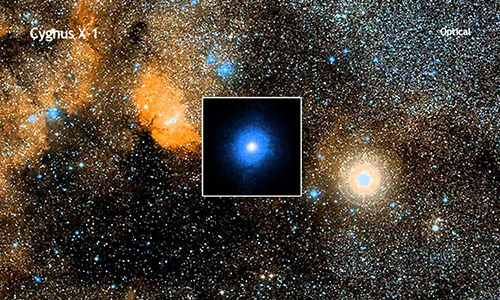
The first real black hole we detected was Cygnus X-1 (in our galaxy) in the late 1960s. Astronomers noticed a bright blue star orbiting something invisible. The only explanation: the unseen companion was a black hole gobbling material from its partner.
So, in short: Einstein predicted them, Schwarzschild and others did the math, Wheeler named them, and observations in the ’60s confirmed they’re real objects out there.
How Big Are Black Holes?
Black holes come in all sizes. The “size” of a black hole usually means the diameter of its event horizon (the point of no return).
Tiny Black Holes
Theoretical ones can be as small as an atom but with the mass of a large mountain. Imagine squashing Mt. Everest into an atom! These tiny ones might have formed early in the universe.
Stellar Black Holes
Typical ones from star collapse are a few miles across but as massive as 3–20 Suns. The smallest of these could be only the size of a city.
Supermassive Black Holes
The monsters at galaxies’ centers have millions or billions of Suns’ worth of mass. For example, Sagittarius A* (the Milky Way’s center) has ~4 million Suns packed inside a region the size of our solar system.
What’s Inside a Black Hole?
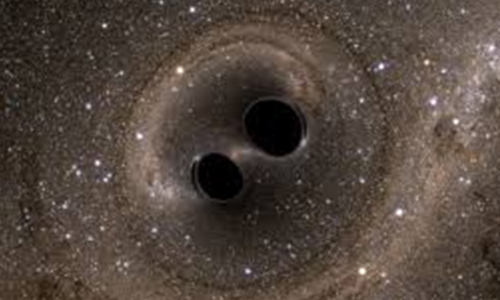
Once you pass the event horizon (the “surface” of a black hole), all paths lead inward. General Relativity predicts that inside lies a singularity – a point where matter is crushed to infinite density. In plain terms, all the black hole’s mass sits at one point so dense that our physics breaks. What happens at that singularity, we honestly don’t know – it’s one of the universe’s biggest mysteries. NASA explains it like this: the event horizon is a boundary where escape velocity exceeds light speed. Anything crossing it (rock, gas, you) is doomed to fall to the center. At that center, the theory says matter is squished to infinite density.
In other words, a black hole contains everything that fell in, concentrated into an unimaginably small point. Inside a black hole is not empty space; it’s gravity and crushed matter. There’s no “stuff” to touch, just whatever fell in and extreme curvature of space. So asking “what’s it made of” is a bit odd – it’s basically mass itself, squeezed. NASA quips that a black hole forms when “matter has been squeezed into a tiny space”.
Can a Black Hole Hit Earth?
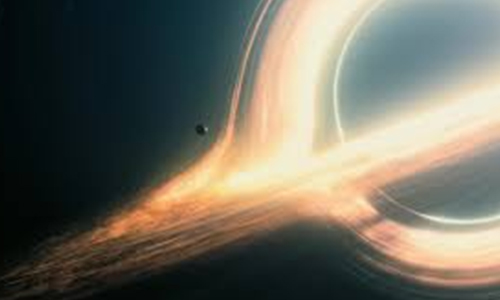
Phew – no. Space is vast, and no black hole is on a collision course with us. In fact, even if our Sun were magically replaced by a black hole of the same mass, Earth’s orbit would stay the same. The gravity would be identical, so we’d zip around the black hole just like we orbit the Sun now! NASA emphasizes that black holes don’t wander around devouring planets nearby. We’d only notice a black hole if it were super close (and none are). Moreover, the Sun is nowhere near massive enough to become a black hole. It will instead puff up into a red giant billions of years from now – Earth might get roasted, but not sucked in. So relax: Earth won’t be gobbled by a roaming black hole.
How Could We “See” a Black Hole?
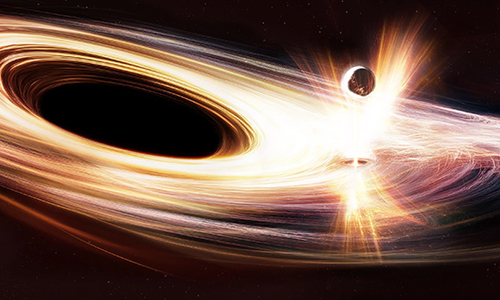
Since black holes emit no light, astronomers rely on indirect clues:
Orbiting Stars
If we spot a star orbiting something invisible, that’s a hint. In our galaxy, stars orbit around Sagittarius A* at the center – revealing a 4-million-sun black hole. We also see stellar couples where one unseen partner wobbles a visible star (like Cygnus X-1).
X-rays and Accretion Disks
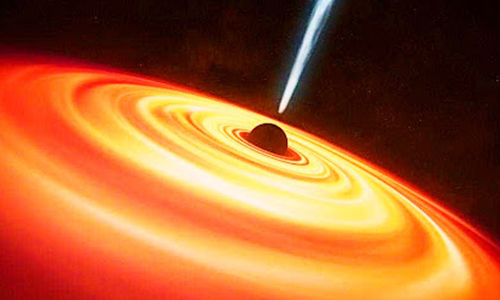
Gas falling into a black hole heats up and glows in X-rays. Space telescopes (e.g. Chandra) catch these glowing disks. NASA notes that we see the “light emitted by surrounding matter that hasn’t yet dipped into the event horizon”. A bright, hot whirlpool of gas around a dark center screams “black hole here!”
Gravitational Lensing
A black hole’s gravity can bend light like a cosmic magnifying glass. If it passes in front of a star, the star’s light can bend and brighten. Astronomers look for such lensing events to spot isolated black holes.
Gravitational Waves
When two black holes collide, they create ripples in spacetime. Detectors like LIGO actually heard these gravitational waves (first in 2015 from colliding black holes), so we “seen” them in sound!
Direct Imaging (EHT)
The coolest trick: The Event Horizon Telescope network linked radio dishes around Earth to become a planet-sized telescope. In 2019 it captured the first image of a black hole’s shadow.
In the image above (released 2019), the glowing ring is the hot gas around a black hole and the dark center is its shadow. It’s the supermassive black hole at the center of galaxy M87, 55 million light-years away. We aren’t seeing the hole itself (it’s the black part), but the bright ring shows the edge of the event horizon. This is literally what a black hole looks like to our eyes (or telescopes)!
Black Hole Fun Facts & Myths
- Not cosmic vacuum cleaners: Unlike cartoon vacuums, black holes don’t randomly suck in everything. They just act like any other mass. If our Sun became a black hole (same mass), Earth’s orbit wouldn’t change – we’d just orbit darkness.
- Spaghettification: If you fell toward a black hole feet-first, the gravity on your feet would be much stronger than on your head, stretching you into a noodle – scientists amusingly call this “spaghettification.” (So maybe don’t try it!)
- They do evaporate: Stephen Hawking showed that black holes can slowly leak away radiation over mind-boggling times. Eventually even black holes might vanish, but it takes far longer than the age of the universe for stellar-mass ones!
- Size vs Mass: The event horizon (size) grows with mass. So a bigger-mass black hole has a bigger ‘shadow’. But the singularity (actual mass point) is infinitely small.
- Our closest neighbor: The nearest known black hole is Gaia BH1, “only” 1,560 light-years away – far enough to be no threat (and it’s only a few solar masses).
FAQs
What exactly is a black hole in simple terms?
A black hole is a region in space where gravity is so incredibly strong that nothing — not even light — can escape it. It forms when a massive amount of matter gets compressed into an extremely tiny space. Think of it like an invisible cosmic drain: anything that gets too close gets pulled in and can never come back out.
Can a black hole destroy Earth?
No — and there’s no need to worry. No black hole is anywhere near Earth on a collision course. The nearest known black hole (Gaia BH1) is about 1,560 light-years away — an enormous, safe distance. Black holes don’t randomly wander through space sucking up planets. They behave like any other massive object — only pulling in things that come dangerously close.
What would happen if you fell into a black hole?
If you fell into a black hole feet-first, you’d experience a bizarre process scientists call “spaghettification” — the gravity on your feet would be so much stronger than on your head that your body would be stretched like a noodle. Once you cross the event horizon (the point of no return), all paths lead only inward toward the singularity. From the outside, observers would see you appear to freeze and fade — a result of extreme time dilation near the event horizon.
How do scientists see something that is completely invisible?
Scientists detect black holes through their effects on surrounding matter, not by seeing them directly. Key methods include watching stars orbit an invisible object, detecting X-rays from superheated gas spiraling into the black hole, spotting gravitational lensing (light bending around it), and measuring gravitational waves from black hole collisions. In 2019, the Event Horizon Telescope captured the first-ever image of a black hole’s shadow — the dark center surrounded by a glowing ring of gas.
What is the event horizon of a black hole?
The event horizon is essentially the “point of no return” around a black hole. It’s not a physical surface — it’s a boundary in space. Once any object (or light) crosses this boundary, the escape velocity exceeds the speed of light, making escape physically impossible. The size of the event horizon grows with the mass of the black hole — a more massive black hole has a larger event horizon.
How many types of black holes are there?
Scientists currently recognize three main types: (1) Stellar black holes — the most common, formed from dying massive stars, typically 3–20 times the mass of our Sun. (2) Supermassive black holes — monsters at the centers of galaxies, containing millions to billions of solar masses. Our Milky Way has one called Sagittarius A*. (3) Primordial black holes — theoretical micro black holes thought to have formed in the early moments after the Big Bang.
Will our Sun ever become a black hole?
No — our Sun is not massive enough to become a black hole. Stars need to be roughly 8–10 times the Sun’s mass or more to end their lives as black holes. Our Sun will instead eventually expand into a red giant in about 5 billion years, then shrink into a dense, cooling object called a white dwarf. No black hole, no supernova — just a quiet stellar retirement.
Do black holes last forever?
Not quite. Physicist Stephen Hawking theorized that black holes slowly lose energy through a process now called Hawking radiation — tiny particles that leak away from just outside the event horizon over time. Eventually, a black hole could completely evaporate. However, the timescale is almost incomprehensible — a stellar-mass black hole would take far longer than the current age of the universe to fully disappear.
What is at the center of a black hole?
At the very center of a black hole lies what physicists call a singularity — a point where all the black hole’s mass is theoretically compressed into zero volume, creating infinite density. At this point, our known laws of physics completely break down. What actually happens inside a singularity remains one of the greatest unsolved mysteries in all of science, sitting at the intersection of general relativity and quantum mechanics.
What was the first black hole ever photographed?
The first-ever photograph of a black hole was released on April 10, 2019, captured by the Event Horizon Telescope (EHT) — a planet-sized network of synchronized radio dishes. The image showed the supermassive black hole at the center of galaxy M87, located about 55 million light-years from Earth. The iconic image revealed a glowing orange ring of superheated gas with a dark shadow at the center — the black hole’s silhouette against its accretion disk.
What is the closest black hole to Earth?
The closest known black hole to Earth is Gaia BH1, discovered in 2022, sitting approximately 1,560 light-years away in the constellation Ophiuchus. It has a mass of around 10 times that of our Sun. Despite being the nearest known black hole, it poses absolutely zero threat to Earth — the distance is enormous on any human scale.
Can anything escape a black hole?
Once something crosses the event horizon, nothing can escape — not matter, not light, not information. However, Hawking radiation is theorized to slowly leak energy away from just outside the event horizon over astronomical timescales. Some physicists also debate the “black hole information paradox” — whether information about what fell in is truly lost forever or somehow encoded in the radiation that leaks out. This remains an open question in theoretical physics.
Black holes might sound scary, but they’re just nature’s way of packing a lot of matter into a tiny space. They warp space and time, bending light and challenging our understanding of physics. We detect them not by seeing them directly, but by their effects: glowing gas, orbiting stars, gravitational waves, and even photographs of their dark shadow.
As Stephen Hawking quipped, they’re not just voids – they’re cosmic monsters that slowly leak light. Studying them teaches us about gravity, space, and maybe the fate of the universe. Who knew that the strange concept we call “what is a black hole” could be explained in (mostly) everyday terms? Now, the next time someone asks, you can say a black hole is a place where gravity has won the ultimate tug-of-war – with a dash of humor for good measure!