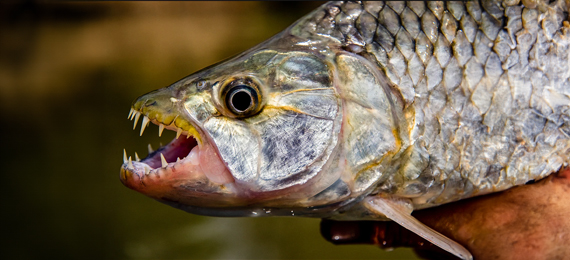
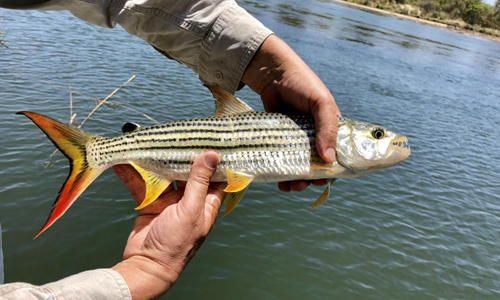
We have all heard of the words, “tiger” and “fish.” But how many of us know the term, “tigerfish?” Yes, it’s a type of fish that is widely considered the cousin of another fish species called, “piranha.” The tigerfish is commonly found in the African waters. It gets its name from its ferocious nature and also from the black stripes (just like a tiger’s) that run along the length of its body. The tigerfish is surrounded by lots of evil myths, and some large-sized fish can look terrifying! Let’s look into some fascinating facts about this enchanting fish species! Also read: Highly migratory marine species.
Where Can You Find Tiger Fish?
- The fish can be found in highly-oxygenated waters. So, they usually thrive in lakes and rivers that have rapidly flowing freshwater.
- They prefer warmer climates; tigerfish live in abundance in the Gambia, Zambezi, and Nile rivers of Africa.
- You can see tigerfish swimming close to the surface of the water during the day. However, they move towards the bottom of the water at night.
- They also prefer strong water currents, where smaller fish thrive in large quantities.
Size
The tigerfish has yellow stripes on its body.
- A. True
- B. False
- The tigerfish can grow to a pretty large size. The Goliath Tigerfish gets its name from the story, “David and Goliath.” It is the biggest in the family, can grow up to 110 pounds, and reach as much as 5 feet in length.
- It has also earned the nickname, “M’Benga,” which translates to “dangerous fish” in the Swahili language.
- Goliath Tigerfish are widely found in Lake Tanganyika and the Congo River Basin.
- The juvenile Goliath Tigerfish grows by 4 to 6 inches a year. Therefore, it can take around 10 years to reach its full adult size. The biggest fish on record is believed to weigh 154 pounds! Talking about fish, you will find this blog on the oldest fish fossils ever found interesting!
Parts of the Tiger Fish
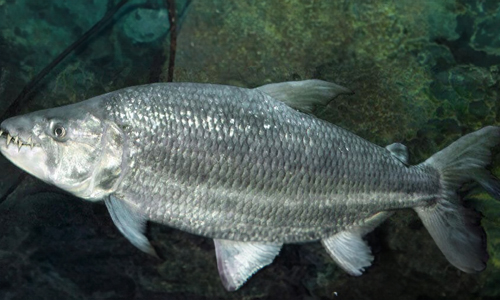
- The males are much bigger than the females. The tigerfish has all the same parts that a normal fish has.
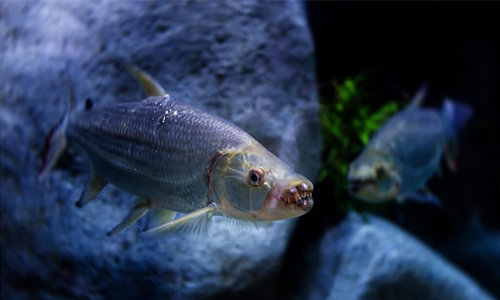
- The eyes are large with big black pupils. They look alert, and sometimes, deadly.
- The fish has an upright dorsal fin. You can also see three smaller fins beneath the stomach.
Teeth
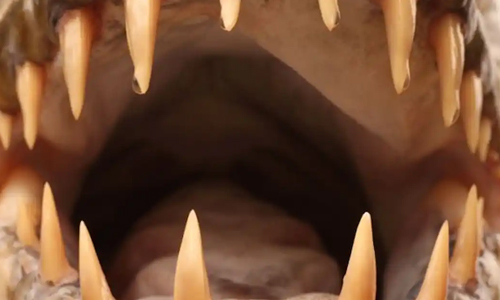
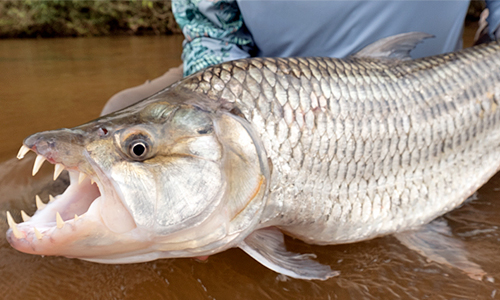
- The Goliath Fish has razor-sharp teeth that look menacing. They can have a maximum of 32 teeth, with the upper jaw containing 12 to 20 teeth, and the lower one with 8 to 14.
- When the tigerfish closes its jaws, the teeth interlock, and some of them protrude from the jaws, giving it a ferocious appearance.
- The teeth are conical in shape and well-separated. They look similar to shark teeth.
- The tigerfish can open its mouth wider than the other species of fish.
- It can attack crocodiles and even humans with their sharp teeth! It can use its teeth to take out huge chunks of flesh from its prey. It can even use its teeth to cut its prey into two halves with a single bite.
- The teeth are not used much for chewing the prey. However, after the fish tears its prey into pieces, it just swallows the parts whole!
Color
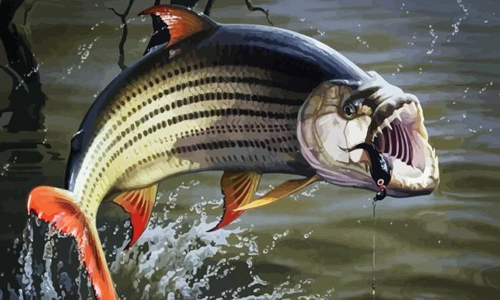
- Most tigerfish look silvery in color, with thin black stripes on the body.
- The body of the native tigerfish is elongated, and its scales are slightly white, brown, and gray.
- Some of the tigerfish’s faces are golden yellow.
What Does the Tiger Fish Eat?
- The tigerfish feeds on other fish species that are available in large quantities. So, they are said to be “piscivores.” Usually, they feed on gobies, cichlids, and catfish.
Must Read: Why fish are named after other animals?
- Small or juveniles usually hunt for their food in groups. However, the adult fish hunts alone. Juveniles are also known to feed on animal plankton.
- As the fish grows, its prey will become larger in size.
- The Goliath Fish eats chunks of flesh from other fish and animals, especially the ones standing on river banks. It even adopts a cannibalistic nature whenever food becomes scarce.
How Does the Tiger Fish Breed?
- The tigerfish usually breeds during December or January.
- The female tigerfish searches for a place on lakeshores or riverbanks to lay its eggs. As soon as it finds a suitable breeding place, the tigerfish lays thousands of eggs.
- At times, it can lay up to 750,000 eggs!
Can You Eat Tiger Fish?

- Even though the tigerfish is a huge predator, it is considered edible!
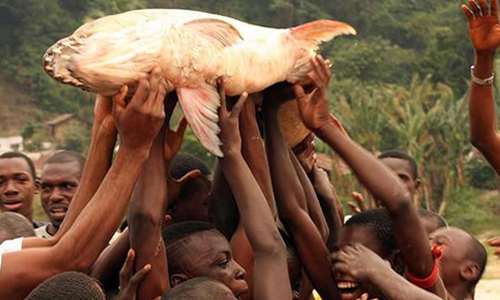
- A single adult tigerfish, when caught, can become a meal for many African villagers!
- African fishermen consider it a prized possession.
- You can fry, bake, or grill your tigerfish.
- It tastes just like “Tilapia,” which is another species of freshwater fish.
Is the Tiger Fish Endangered?
- No. The tigerfish is not an endangered species. In fact, it’s said to be a thriving species. So far, there have been no clear rules or restrictions about hunting this Fish.
FAQs
Q1. Is tigerfish more dangerous than a piranha?
Many experts consider the tigerfish more dangerous than the piranha — it’s faster, larger, and is the only freshwater African fish with documented attacks on humans. Unlike piranhas, some species can even snatch birds out of the air.
Q2. What is the scientific name of the tigerfish?
The most famous species is the Goliath Tigerfish, scientifically known as Hydrocynus goliath. The common African tigerfish is called Hydrocynus vittatus, where “Hydrocynus” is Greek for “water dog.”
Q3. Why is it called a tigerfish?
Tigerfish are named after the construction of their teeth and jaws and their horizontal black stripes, similar to those of a tiger. Their fierce, predatory nature also contributes to the name.
Q4. How fast does a tigerfish swim?
Tigerfish are exceptionally fast swimmers built for fast-flowing river currents. They are extremely strong swimmers due to their preference for fast-moving waters, which allows them to snatch prey even in the most turbulent conditions.
Q5. How long does a tigerfish live?
The Goliath Tigerfish has a slow growth rate and a notably long lifespan. Since juveniles grow only 4 to 6 inches per year, it takes around 10 years to reach full adult size, suggesting a lifespan of well over a decade.
Q6. Do tigerfish hunt in groups or alone?
It depends on their size. Smaller tigerfish hunt in large schools, while larger African tigerfish tend to hunt alone. This makes adult tigerfish solitary apex predators in their habitats.
Q7. How do tigerfish reproduce?
Mating begins with the female scattering her eggs throughout the water, which the male then swims over to fertilize — a process known as spawning. After hatching, young fish join a school for protection.
Q8. What are the main threats to tigerfish populations?
According to the IUCN Red List, tigerfish are of least concern overall, but are locally threatened by overfishing, pollution, deforestation, and dams that block migration routes.
Q9. What is the nickname of the tigerfish in African culture?
The tigerfish has earned the nickname “M’Benga” in the Swahili language, which directly translates to “dangerous fish” — a testament to the fear and respect it commands across African communities.
Q10. Can tigerfish jump out of water?
Yes — and it’s one of their most remarkable abilities. Tigerfish have been confirmed to leap out of the water to catch barn swallows in mid-flight, the only documented example of a freshwater fish exhibiting this behavior.
The areas where the fish thrive have become suitable tourist locations. These creatures also promote recreational fishing in their habitats.